
Scientists Discover Strange New Deep-Sea Fish Species
By Raúl Nava, Monterey Bay Aquarium Research Institute
Sept. 20/2025
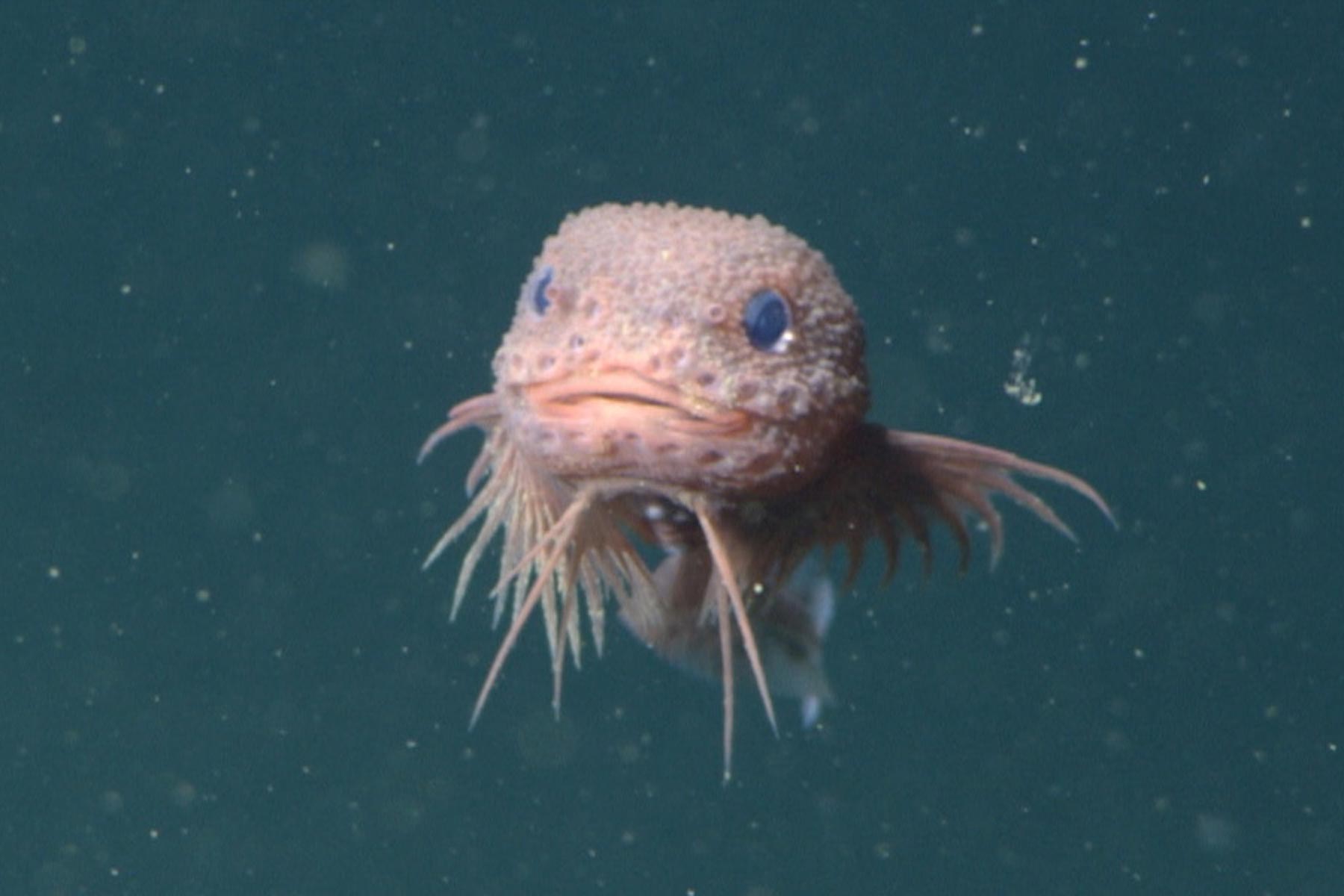
The bumpy snailfish is one of 3 newly identified deep-sea snailfish species described by MBARI collaborators at SUNY Geneseo.
MBARI’s cutting-edge underwater tools are uncovering unique species that inhabit the deep ocean. In 2019, researchers observed a pink snailfish gliding just above the seafloor that did not match any known species. Follow-up research has now confirmed that this fish is a newly identified species, the bumpy snailfish (Careproctus colliculi).
Scientists from the State University of New York at Geneseo (SUNY Geneseo), working with colleagues from the University of Montana & the University of Hawaiʻi at Mānoa, reported their findings in the journal Ichthyology & Herpetology. Their publication describes the bumpy snailfish documented by MBARI researchers along with 2 additional snailfish species found on the abyssal seafloor off the coast of California.
“MBARI seeks to make ocean exploration more accessible by sharing our data & technology with our peers in the science community. We welcomed the opportunity to collaborate with researchers from SUNY Geneseo to expand our understanding of life in the deep ocean, especially since documenting deep-sea biodiversity is critical to detecting any changes that may be occurring in this environment,” said MBARI Senior Scientist Steven Haddock, who led the research expedition that encountered the bumpy snailfish.

Uncovering secrets to survival in extreme environments
Snailfishes are members of the family Liparidae. They are characterized by their large heads, soft, gelatinous bodies with loose skin, & slender tails. Many species possess a specialized disk on their underside that helps them attach to the seafloor or even ride along on larger animals like deep-sea crabs. In shallower waters, some species use this disk to cling to rocks & seaweed, curling their bodies much like a snail.
More than 400 species of snailfish have been formally identified across the globe. They occupy an impressive range of marine environments, from coastal tide pools to the planet’s deepest ocean trenches. In fact, the deepest-living fish ever recorded is a snailfish.
At SUNY Geneseo, Associate Professor Mackenzie Gerringer focuses on deep-sea snailfishes while studying physiology & ecology in extreme environments. Her research combines taxonomy, functional morphology, & physiology to uncover how these fishes survive in conditions defined by immense pressure, freezing temperatures, & constant darkness.
“The deep sea is home to an incredible diversity of organisms & a truly beautiful array of adaptations. Our discovery of not one, but 3, new species of snailfishes is a reminder of how much we have yet to learn about life on Earth & of the power of curiosity & exploration,” said Gerringer.
Chance encounters spark new discoveries
MBARI’s Biodiversity & Biooptics Team observed the newly described bumpy snailfish during an expedition aboard the institute’s retired flagship research vessel Western Flyer. Haddock & his team were exploring the outer reaches of Monterey Canyon, approximately 100 kilometers (62 miles) offshore of Central California, with MBARI’s remotely operated vehicle Doc Ricketts at a depth of 3,268 meters (10,722 feet) when they observed this small snailfish swimming above the abyssal seafloor.
MBARI researchers collected this individual—an adult female 9.2 centimeters (3.6 inches) long—for further study in the laboratory. With features unlike other deep-sea snailfishes that MBARI had encountered offshore of California, Haddock reached out to Gerringer for more detailed analysis. MBARI frequently collaborates with expert taxonomists to review footage & specimens. These partnerships offer fresh perspectives that often spark new discoveries.
New additions to the family
Gerringer & researchers from the University of Montana & the University of Hawaiʻi at Mānoa, including former MBARI postdoctoral fellow Jeff Drazen, examined the bumpy snailfish as part of a comprehensive analysis of 3 unusual snailfish specimens collected offshore of California. The team combined imaging, morphological, & genetic approaches to compare these snailfishes to other known fishes.
Using microscopy, micro-computed tomography (micro-CT) scanning, & careful measurements, the team collected detailed information about the size, shape, & physical characteristics of the 3 fishes, distinguishing them from all known species. They also sequenced the DNA of the specimens to compare these animals to other snailfishes & determine their evolutionary position in the family Liparidae. Their examination confirmed that all 3 snailfishes were new to science. The team has made their CT scan data publicly available via MorphoSource & genetic sequence data via GenBank (PV300955-PV300957 & PV298545-PV298546).
In addition to the bumpy snailfish, the SUNY Geneseo team described the dark snailfish (Careproctus yanceyi) & the sleek snailfish (Paraliparis em).
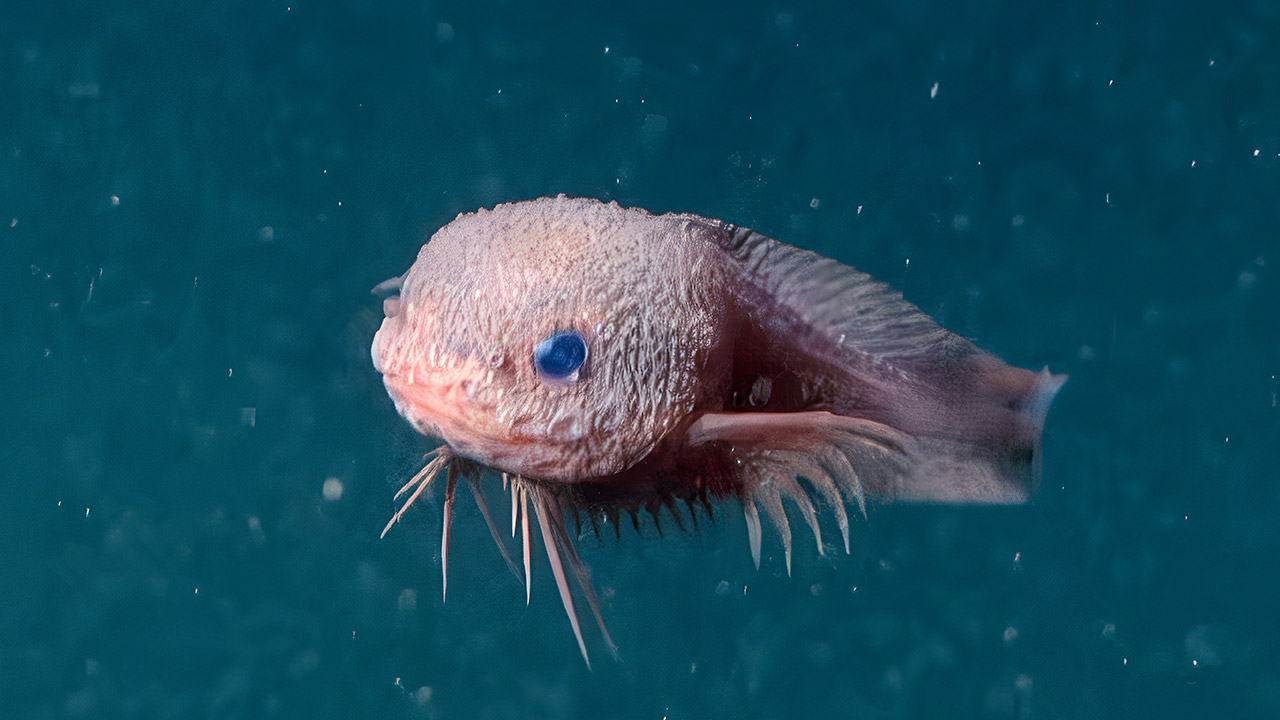
The bumpy snailfish has a distinctive pink color, a round head with large eyes, wide pectoral fins with long uppermost rays, & a bumpy texture. The dark snailfish has a fully black body with a rounded head & horizontal mouth. The sleek snailfish is distinguished from other snailfishes by a long, black, laterally compressed body, absence of a suction disk, & prominently angled jaw.
Both the dark & sleek snailfishes were collected in 2019 by Drazen & colleagues during an expedition with the submersible Alvin at Station M, a research site operated by MBARI offshore of Central California at a depth of approximately 4,000 meters (13,100 feet). MBARI scientists & researchers worldwide have leveraged a unique 30-year dataset collected by a suite of advanced instruments at Station M to make several important discoveries about abyssal ecosystems & the ocean-climate connection. The species name of the sleek snailfish, Paraliparis em, recognizes this unique research site & the people & programs that have supported the Station M time series.
Haddock’s encounter is the only confirmed observation of the bumpy snailfish, so the full geographic distribution & depth range of this species remain unknown. However, a closer look at MBARI’s extensive archive of underwater video suggests this species may have been previously encountered offshore of Oregon in 2009 and mistaken for a similar species, the bigtail snailfish (Osteodiscus cascadiae).
Cataloging life in the depths
The deep sea is the largest living space on Earth. The inky waters beneath the ocean’s surface teem with life, including many species unknown to science. With threats like climate change & mining putting deep-sea communities at risk, documenting the residents of this environment is more urgent than ever.
Over the past 38 years, MBARI researchers & our collaborators have discovered more than 300 new species. We share video footage & specimens with taxonomy experts around the world, giving other researchers access to the deep sea. MBARI science & technology are helping establish a baseline understanding of ocean health & deep-sea biodiversity so we can better assess how climate change, pollution, mining, & other human activities will affect the marine ecosystems. From the mesmerizing “mystery mollusk” to the carnivorous harp sponge, each discovery is a new piece of the puzzle.
Reference: “Descriptions of 3 Newly Discovered Abyssal Snailfishes (Liparidae) from the Eastern Pacific Ocean” by Mackenzie E. Gerringer, Sarah Suplicz, Jessica L. Palmeri, Lydia Fregosi, Brett H. Woodworth, Emily McMahon, Samantha Shepard, Logan M. Peoples, & Jeffrey C. Drazen, 27 August 2025, Ichthyology & Herpetology.
DOI: 10.1643/i2024069
Funding for this work was provided by the U.S. National Science Foundation Division of Ocean Sciences (OCE-1829612), the David & Lucile Packard Foundation, & the SUNY Geneseo Research Foundation.
Scientists Discover Strange New Deep-Sea Fish Species
Cute Critter Pics:


No comments:
Post a Comment