Showing posts with label Pigs. Show all posts

Friday, May 12, 2023

May 10/2023


The Perks of Pigs: Fun Facts About Pigs

By The Editors

almanac.com

4/ 10/2023

Pigs are highly intelligent. They consistently rank between the top 4 & top 7 of the most intelligent animals on Earth. Pigs have a good memory & learn quickly. They are considered by animal experts to be at least as trainable as dogs or cats. Pigs can be house-broken & can be taught to use a litter box, much like a cat. Their ability to solve problems is well-documented. During a study in the 1990’s, pigs were trained to move a cursor on a video screen with their snouts & used the cursor to distinguish between scribbles they knew & those they were seeing for the first time. They learned the task as quickly as chimpanzees.

No barnyard animal has a better sense of smell. The large round disk of cartilage at the tip of the snout is connected to muscle that gives it extra flexibility & strength for rooting in the ground. By rooting, & thus disturbing the soil, pigs disperse plant seeds & play an important role in managing ecosystems. Pigs’ sense of smell is so keen that they can smell something that is 25 feet underground! Their sense of smell can also help humans. Some pigs are trained to law enforcement. They can sniff out drugs, just like dogs.

Pigs are one of the cleanest animals. Huh? They have the reputation for being slovenly because they wallow in mud. However, pigs lack sweat glands. They roll around in the mud to stay cool in hot weather. Caking mud on their bodies also prevents sunburn & deters insect infestation. Without mud, pigs could get second-degree burns all over their body.

But why do pig seem to smell so much? A bare pig is odor-free; the odor comes from their living style. If pigs have enough room, they keep their toilet area far away from where they live & muck about. Even newborn piglets will leave the nest to go to the toilet within hours of birth. However, as pigs are often confined or their living area isn’t cleaned frequently enough, the mud, fecal matter, & food waste create various odoriferous gases. Some of these odor-causing chemicals aren’t that different from our own human latrines; it doesn’t matter if it’s of livestock or human origin. 

Ever heard the expressing “pigging out”? Pigs do have a reputation for being gluttonous, messy eaters. They making snorting & smacking sounds, & just delight in eating. (Hey, who are we to judge?) Pigs primarily like to dine on roots & vegetables; this is what they eat in the wild. However, they will eat just about anything you give them. (There’s a joke that says pigs would even eat you, just as we would eat them!) Interestingly, the stomach of a pig is proportionately much smaller than that of a sheep or a cow. They are naturally lean, too, unless they are overfed by humans.

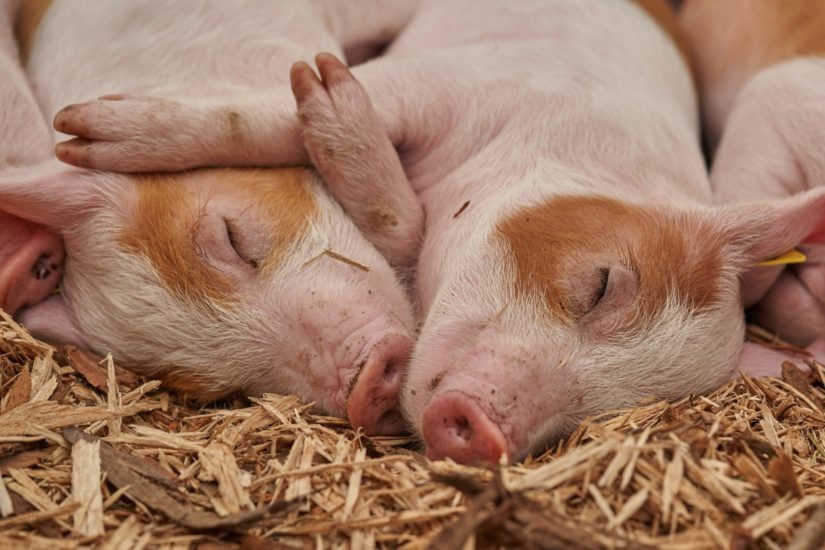
The pig is the friendliest animal on the farm by far: always available for a scratch behind the ears, hardly ever moody, & quick with a grunt of delight. They love to play & engage in mock fighting with each other, similar to play in dogs & other mammals. They form close bonds with other animals & love to cuddle & lie down against each other.

Pigs are social. They live in complex social communities where they keep track of individuals & learn from one another. They cooperate with one another, & prefer living in groups, just as a dog likes to be part of a pack. Also, like dogs, they respond to the “top pig,” & will not necessarily think you are the “boss” if you don’t act like one. Winston Churchill famously said that “Dogs look up to man. Cats look down to man. Pigs look us straight in the eye & see an equal.”

Pigs are very peaceful animals & rarely show aggression, even though some pigs are very large & sometimes have tusks. They’ll only show aggression if they or their young are threatened. Pigs are athletic, too; the fastest member of the pig family is the warthog, which can reach speeds of 35 MPH. Interestingly, the pig has cloven hooves—an adaptation shared with more timid prey animals like the sheep, deer, & antelope; pigs, however, are neither timid nor afraid. 
Looking for how to find out how much your pig weighs? Measure its girth (in inches) by wrapping a tape measure around the animal just behind the front legs. Then measure the length from the ears to the base of the tail. The pig’s weight (in pounds) will be equal to the square of the girth, times the length, divided by 400. If math isn’t your thing, buy a hog tape at the feed store; the calculations are built in.

Cute Critter Pics:


Weekly Chuckle:


Thursday, March 31, 2022

March 30/2022

                                                                              The Perks of Pigs: Fun Facts About Pigs    

"Pigs are smart, social, & often misunderstood...

Agriculture itself could scarcely have evolved eons ago without the recycling abilities of the pig...

Amazing Facts About Pigs
Pigs are highly intelligent. They consistently rank between the top 4 & top 7 of the most intelligent animals on Earth. Pigs have a good memory & learn quickly. They are considered by animal experts to be at least as trainable as dogs or cats. Pigs can be house-broken & can be taught to use a litter box, much like a cat. Their ability to solve problems is well-documented. During a study in the 1990’s, pigs were trained to move a cursor on a video screen with their snouts & used the cursor to distinguish between scribbles they knew & those they were seeing for the first time. They learned the task as quickly as chimpanzees.

No barnyard animal has a better sense of smell. The large round disk of cartilage at the tip of the snout is connected to muscle that gives it extra flexibility & strength for rooting in the ground. By rooting, & thus disturbing the soil, pigs disperse plant seeds & play an important role in managing ecosystems. Pigs’ sense of smell is so keen that they can smell something that is 25 feet underground! Their sense of smell can also help humans. Some pigs are trained to law enforcement. They can sniff out drugs, just like dogs.

Pigs are one of the cleanest animals.
Huh? They have the reputation for being slovenly because they wallow in mud. However, pigs lack sweat glands. They roll around in the mud to stay cool in hot weather. Caking mud on their bodies also prevents sunburn & deters insect infestation. Without mud, pigs could get second-degree burns all over their body.

But why do pig seem to smell so much? A bare pig is odor-free; the odor comes from their living style. If pigs have enough room, they keep their toilet area far away from where they live & muck about. Even newborn piglets will leave the nest to go to the toilet within hours of birth. However, as pigs are often confined or their living area isn’t cleaned frequently enough, the mud, fecal matter, & food waste create various odoriferous gases. Some of these odor-causing chemicals aren’t that different from our own human latrines; it doesn’t matter if it’s of livestock or human origin. 

Ever heard the expressing 'pigging out'? Pigs do have a reputation for being gluttonous, messy eaters. They making snorting & smacking sounds, & just delight in eating... Pigs primarily like to dine on roots & vegetables; this is what they eat in the wild. However, they will eat just about anything you give them... Interestingly, the stomach of a pig is proportionately much smaller than that of a sheep or a cow. They are naturally lean, too, unless they are overfed by humans.

The pig is the friendliest animal on the farm by far: always available for a scratch behind the ears, hardly ever moody, & quick with a grunt of delight. They love to play & engage in mock fighting with each other, similar to play in dogs & other mammals. They form close bonds with other animals & love to cuddle & lie down against each other.

Pigs are social. They live in complex social communities where they keep track of individuals & learn from one another. They cooperate with one another, & prefer living in groups, just as a dog likes to be part of a pack. Also, like dogs, they respond to the 'top pig,' & will not necessarily think you are the 'boss' if you don’t act like one. Winston Churchill famously said that 'Dogs look up to man. Cats look down to man. Pigs look us straight in the eye & see an equal.'

Pigs are very peaceful animals & rarely show aggression, even though some pigs are very large & sometimes have tusks. They’ll only show aggression if they or their young are threatened. Pigs are athletic, too; the fastest member of the pig family is the warthog, which can reach speeds of 35 MPH. Interestingly, the pig has cloven hooves—an adaptation shared with more timid prey animals like the sheep, deer, & antelope; pigs, however, are neither timid nor afraid. 

Looking for how to find out how much your pig weighs? Measure its girth (in inches) by wrapping a tape measure around the animal just behind the front legs. Then measure the length from the ears to the base of the tail. The pig’s weight (in pounds) will be equal to the square of the girth, times the length, divided by 400. If math isn’t your thing, buy a hog tape at the feed store; the calculations are built in..."


Chuck Wooster
March 21/2022
almanac.com 

Cute Critter Pics: 


Weekly Chuckle


networkforanimals.org
https://www.vetswithoutborders.ca/


Wednesday, December 16, 2020

Dec. 16/2020

Feature:

8 Surprising Facts About Pigs

"Pigs are among the most versatile animals humans have domesticated. While they're often stereotyped as gluttonous, dirty, & not particularly bright, anyone familiar with actual pigs knows they're incredibly intelligent & complex creatures. Here are some fun, surprising facts about pigs.

1. Humans Domesticated Pigs at 2 Different Times, in 2 Different Places

...2 different cultures thousands of miles apart domesticated wild pigs, or boars. Near what is now modern-day Turkey, settlers domesticated wild boars that came to their villages for scraps of food about 10,000 years ago. Research also indicates that around 8,000 years ago, wild pigs were domesticated in China's Mekong Valley.

2. Pigs Developed a Dirty Reputation

Despite their domestication & usefulness, pigs fell out of favor to a certain degree around 3,000 years ago. The Old Testament of the Bible, specifically the Book of Leviticus, deemed pigs 'unclean' & forbade the consumption of pig productions. The Quran followed suit in the 7th century. While theories abound as to why pigs were held in low esteem, the likeliest reason is that pigs are happy to consume just about anything, including decaying food & even feces.

3. The Pig Holds a Place in the Chinese Zodiac

The pig is the 12th symbol in the 12-year cycle of the Chinese zodiac...The pig, having gotten hungry & then sleepy during the race, was the last to arrive at a meeting called by the Jade Emperor, according to folklore.

4. Pigs Can Save Human Lives

...Pigs' heart valves are used to make valves for humans. According to Harvard Health Publishing, these valves last around 15 years & typically don't require the use of anti-clotting drugs as mechanical valves do...


5. Pig Are Intelligent, Emotional Creatures

A review of pig studies published in the International Journal of Comparative Psychology
suggests pigs have a complex psychology that we're only now beginning to understand. 'Pigs display consistent behavioral & emotional characteristics that have been described variously as personality. e.g., coping styles, response types, temperament, & behavioral tendencies,' the authors wrote.

The review also found that pigs respond to each other's emotions. 'Emotional contagion in pigs involve[s] responses to other pigs' anticipation of positive or negative events, revealing the importance of social factors in emotion.'

6. They Even Use Tools

Ecologist Meredith Root-Bernstein was studying some special pigs in France when she noticed a behavior that had never been noted before. Visayan warty pigs were using sticks & bark scraps to build nests...These specific pigs are endangered, which is why she was studying them in a zoo environment, but the unprompted behavior counts, according to Root-Bertstein. The nest building doesn't happen all the time, only every 6 months or so when the pigs are expecting the arrival of piglets.

7. Pigs Don't Really Sweat

...the truth is pigs don't sweat a lot. Sweat is a way warm-blooded animals keep cool, but they need functional sweat glands to do that. Pigs have the glands, but they don't work well. This is why pigs will roll around in mud to keep cool.

8. Pigs Have Crummy Vision but a Great Sense of Smell

Pigs can see things along the sides of their head- useful for spotting food, other pigs, & potential predators-but they're not great at seeing what's right in front of them. They make up for this poor frontal vision with an excellent sniffer. They can use their snouts to detect food, & thanks to a little extra muscle that gives it flexibility, the snout also can root out food."

Treehugger.com

Noel Kirkpatrick

August 12/2020

Cute Christmas Critter Pics:


Weekly Chuckle:

#StaySafe