
The Cecropia Moth: Art on the Wing
By Jamieson Findlay
July 22/2025
The Cecropia Moth is one of Canada’s most beautiful moths, but that beauty is fleeting — it lives for only about 2 weeks in its adult form.
Cecropia moths are night-loving works of art — & vital to the ecosystem as pollinators & food for predators.
The largest moth species in North America, Cecropia is named after the mythical ruler of Athens, Cecrops. He was said to have a man’s head & torso with a snake’s form below. You can almost see this fanciful being in the beautiful wing markings of the moth. The eyespots & “commas,” if looked at in the right way, hint at a snake’s face. Predators might think twice about tackling that face.
Like all moths, the Cecropia moth goes through several life stages: egg, larva (caterpillar), pupa (chrysalis), & adult (imago). The female lays its eggs on both sides of a leaf from the host plant, which include such trees as oak, beech, cherry, & apple. The eggs hatch into caterpillars which, being jam-packed with protein, are a favourite meal for many birds.
The caterpillars will grow up to 5 inches long & eventually spin silk cocoons (the chrysalis stage). Inside the cocoon, they stay dormant until they are ready to emerge as adults.
The final stage, the adult stage, is fleeting even by insect standards. Adult Cecropia moths last about 2 weeks. They can’t eat during this stage, since they have no digestive system or moveable mouth parts. About the only thing they can do is mate! An adult Cecropia moth is basically a work of art designed to create more works of art.
Populations of Canada’s most endangered species have declined by more than 50% over the last 50 years.
What’s the difference between a butterfly & a moth?
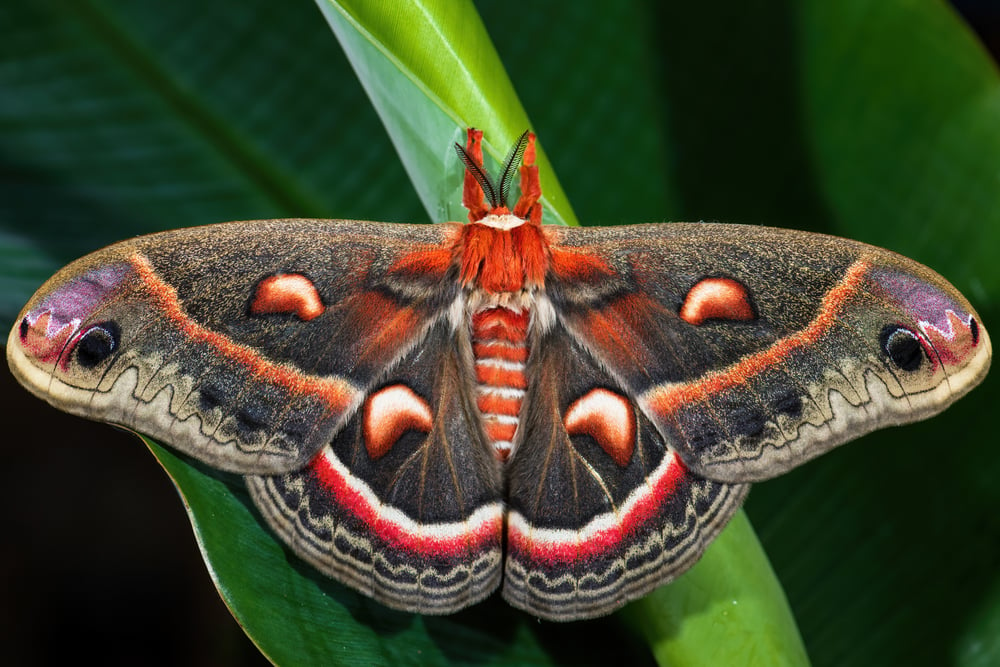
Both moths & butterflies belong to the order Lepidoptra, but what’s the difference?
Wings: when resting, butterflies generally hold their wings closed, often raised on either side of their body. At rest, moths hold their wings open over their abdomen.
Antennae: butterflies have long, thin antennae with bulb-like tips. Moths have feathery, thick antennae.
Behavior: butterflies tend to be active during the day & moths at night, although there are exceptions.
Moths, to your stations!

A great place for observing Cecropia moths is the Long Point Biosphere Region, a 40-km long sand spit in Norfolk County, Ontario, on the north shore of Lake Erie. Staff there have established moth stations to monitor moth species. These stations, equipped with simple grey boards & lights, attract moths & make it easier to observe them. The primary goal is to monitor the diverse moth species in the region & contribute valuable data to understanding their ecological roles & distribution.
Find out more about the moth observation project through i-Naturalist. Moths in Long Point Biosphere Region · iNaturalist
The Cecropia Moth: Art on the Wing - Nature Canada
Cute Critter Pics:


No comments:
Post a Comment