Monday, October 23, 2023

Oct. 18/2023


18 of the Smartest Dog Breeds Part 1

By April Saylor

Reviewed by Barri J. Morrison, DVM on 4/4/2023

petmd.com

All dogs are known for their loyalty & companionship, but many breeds are celebrated for their intelligence, too. The smartest dogs can quickly learn & understand new cues, exhibit problem-solving skills, & show their independent side.

But earning a spot on the list of smartest dog breeds is more than just how fast a pup can learn new tricks. Experts say signs of dog intelligence are a combination of various factors, not just how trainable they are. In fact, some smart pups show their intelligence in ways that can be frustrating for first-time dog parents. Clever dogs with high cognitive abilities may be more likely to show off their creative problem-solving skills, like how to steal snacks off the counter or unlock a gate.

Wondering if your pooch makes the list of most intelligent dog breeds? Here are some of the smartest dogs by breed & the features that make them so clever.

1. Border Collie 

Border Collies are some of the most talented pups you’ll ever meet & are known to quickly learn & respond to cues during training. Need proof? Just look at Rico, a Border Collie who can respond to more than 200 words.

These pups are superstars in agility & obedience competitions, & they have exceptional problem-solving skills. The uber-trainable Border Collie is part of the herding group, so they are happiest when they have a job to do. Their boundless energy means they can work for extended periods without tiring, so they’re excellent companions for farmers & ranchers. Puzzles & energy outlets like dog sports will help them live fulfilling lives if they’re not rounding up sheep on the farm.

2. Poodle

Originally bred as a hunting dog, Poodles have a long history of working alongside their humans. This strong connection to their people means they’re relatively easy to train—they aim to please. Present-day Poodles might be a more common sight curled up on the couch at home, but these smart pups are still frequently at the top of the winner’s podium at obedience & agility competitions. 

3. German Shepherd

German Shepherds are considered one of the smartest dog breeds due to their exceptional intelligence, trainability, & versatility. Their instincts from hundreds of years protecting flocks (hence the “shepherd” name) are still intact today. Because of years spent problem-solving in the field, the adaptable & hard-working German Shepherd still excels in jobs that many humans would find demanding & stressful, like police & military work or on search & rescue missions. 

4. Golden Retriever

With training, Golden Retrievers can excel in various tasks such as hunting, retrieving, obedience, & even service & therapy work. These intelligent sporting dogs have a notoriously gentle nature. Their ability to learn quickly & respond well to commands means they’re relatively easy to train with a pocket full of treats to reward their food-motivated minds.

Goldens are known for being very loyal & affectionate family pets, solidifying their stature as one of the most popular dogs in the U.S. Their gentle demeanor & eager-to-please nature make them an ideal breed for first-time dog parents.

5. Doberman Pinscher

Doberman Pinschers are exceptionally intelligent, loyal, & trainable. These versatile dogs excel in obedience competitions as well as police & military work. While they are known for being highly perceptive, they are also very curious pups. To live their best lives, Dobermans should get plenty of exercise & be able to use their brains as well as their bodies. Their intelligence & athleticism make Dobermans well-suited for active families who have plenty of time to train & play.

6. Shetland Sheepdog

Shetland Sheepdogs are known for their high intelligence, trainability, & excellent problem-solving skills. Also known as Shelties, these quick learners excel in herding, agility, obedience, & working as therapy dogs. While considered affectionate & loyal family pets, their energetic nature & intelligence means they’re best suited for active families who enjoy spending time outside.

7. Labrador Retriever

Labrador Retrievers are some of the friendliest dogs you’ll ever meet, but they’re also super smart! Labs have a long history of working alongside their humans to hunt & retrieve, meaning they’re instinctually perceptive & quick to learn. With adequate training, Labs can become champions in retrieving, obedience, & service & therapy work. They are also loyal & affectionate family pets, making them a popular choice for households with children. Like Golden Retrievers, Labs have a gentle demeanor & eagerness to please that makes them an ideal breed for first-time pet parents.

8. Papillon

Don’t let those cute butterfly ears fool you—Papillons are perceptive little dogs. These tiny balls of energy are quick to learn, making training a breeze. They are also highly active & excel in agility & obedience. Despite their small size, Papillons are confident, energetic, & make loyal family pets. Their affectionate & playful nature also makes them a popular choice for households with children.

9. Rottweiler

Big, burly Rottweilers are known for their loyalty & smarts. With proper training, eager-to-please Rottweilers can excel in obedience competitions & as service dogs. Their intelligence & athleticism make them well-suited for active families who can ensure their Rottweiler gets plenty of mental stimulation, physical exercise, & early socialization. Puzzle toys & enrichment games are a great way to keep your Rottie from getting bored.

Cute Critter Pics:


Weekly Chuckle:


Thursday, October 12, 2023

Oct. 11/2023


Newly discovered pangolin species could aid in fight against extinction

By Jenna Schnuer, CNN

9/27/2023

Pangolins are among the world’s most heavily poached animals. The elusive creatures are under threat, but the discovery of a mysterious species that’s new to science could help conservationists fight against their extinction, researchers say.

There are 8 previously known species of pangolin — 4 found in Asia & 4 in Africa. Resembling anteaters, the solitary mammals are illegally hunted & trafficked for their meat & distinctive armorlike scales, which some people believe have medicinal value. 

Scientists studying contraband scales — confiscated in Hong Kong & China’s Yunnan province between 2012 & 2019 — identified genetic markers not seen in any known pangolins. The genomic analysis revealed an unexpected 9th species, which the team has named Manis mysteria.

The researchers described their findings in a study published Monday in the journal PNAS.

“We were quite surprised because we did not expect a new species could be discovered from seized scales,” said study coauthor Jing-Yan Hu, a research assistant at the State Key Laboratory for Conservation & Utilization of Bio-Resource at Yunnan University, in an email.

The study team did a structural analysis of 33 scale samples from several different confiscations. 5 scales were attached to skin & 3 to claws. The remaining samples were from individual scales found to be from pangolin tails, backs, bellies or heads.

Genomics can help protect threatened species

The scales’ form initially suggested they belonged to one of 4 species of pangolin found in Asia. But DNA analysis showed that their “genomic data provide robust & compelling evidence that it is a new pangolin species distinct from those previously recognized,” Hu said.

Finding a new “large-bodied mammal” is not an everyday occurrence, said Dr. Aryn Wilder, a researcher specializing in conservation genetics at the San Diego Zoo Wildlife Alliance. Wilder was not involved in the new research.

One of the most recent of such finds made through genomics was the 2017 identification of an unknown species of orangutan. “Although not unheard of, discoveries like these are pretty unusual,” Wilder said, adding that the pangolin study’s results were convincing.

“I thought the methods were solid & their findings were pretty conclusive,” she said.

Expanded understanding of ‘pangolin diversity & evolution’

Little is known of Manis mysteria, but now that its existence has been established, conservationists can work to protect it.

Uncovering a 9th species is significant, Hu said. The revelation “greatly expands current knowledge of pangolin diversity & evolution,” Hu said. “The discovery also urges more conservation concerns & joint efforts to help tackle the supply & demand of pangolin trade.”

The finding is very important, Wilder said in an email. “The identification of this new species will allow conservationists to focus management efforts to prevent its extinction.”

Extinction is defined on a species level. “Once a species is extinct, its unique biodiversity is lost,” Wilder said. “With the discovery of a new pangolin species, one that is likely endangered, & with more research to learn about its range, ecology, life-history & conservation status, conservation strategies can be tailored specifically to ensure that this species survives.”

                                                             Because Manis mysteria has just a slight genetic variation from other pangolins, the species is currently described as “cryptic.”

Cryptic species aren’t easy to tell apart from others by appearance alone, so the newfound ability to identify pangolin species by testing scales is a boon for conservation scientists. “Often a rare species will be mistaken for a more common one,” Wilder said. “With advancing DNA technologies, we are getting better at identifying cryptic species.”

That means the recent revelation could just be the start. “We also expect to find other pangolin species,” Hu said.

Cute Critter Pics:


Weekly Chuckle: 



Friday, October 6, 2023

Oct. 4/2023


The World’s Cutest Animals

 June 21/2018 

Reliablecounter Team

https://www.reliablecounter.com/blog/world-cutest-animals/

It is amazing the diversity in the beauty that we have in this world. Great & beautiful are the natural sceneries scattered in different countries across the globe & millions of people hope from one country to another just to experience the beauty found in the lands yonder. But while we talk about beautiful landscapes & natural sceneries, it is also befitting to talk about animals since we don’t live in this world alone. There are thousands of animal species, some living in the wild while some sharing with us the same spaces we have at home. Though you will lose count if you start to determine the total number of animals available in this planet, here is a look at some of the world’s cutest animals:

Sloth

Sloth is a relaxed & highly lovable animal. The commonplace & the natural habitat where you will find this cute animal is in the jungles & the rainforests of South America. Though the name may suggest laziness to some people, sloth is not necessarily a lazy animal, but it will always take its time wherever it goes. Since they move slowly from one place to another, they never attract the attention of predators & their very nature gives them a nice defense mechanism.

Pigmy hippopotamus

The pygmy hippo is one animal that will rarely miss from the list of the cutest animals in the world. Though hippos are naturally very huge & big animals, they are very pretty when they are small & were it not for the fact that they are wild animals, millions would die to have them as pets at home. But with the pygmy hippo, they are very cute & harmless & currently, they are one of the animals marked for extinction in the coming few years.

Slow Loris

Slow Loris features big, brown eyes with a round head & small pointy ears & it is one of the cute baby animals you will ever encounter in your life. It is an exotic animal, native to South & Southeast Asia, & though it has very adorable looks, it is a very dangerous animal. It has a gland on the elbows which excretes very dangerous venom & getting close to it is highly discouraged as just with a snap of the seemingly feeble fingers, you could be left wreathing in pain & in need of emergency medical care.

Meerkat

From afar, you may mistake the meerkat for a mongoose, but it has a characteristic human-like pose & this is what has made them extremely popular. They are cute & highly agile animals & they are native to the deserts of South Africa. The meerkats are social animals & will always live & walk in gangs of about 20 animals each, though it is also common to find them in groups of up to 50 members.

Penguin

There is no denying that penguins are some of the cute animals you will ever find in the world, especially when you are considering sea mammals. Their beauty & cuteness have been the inspiration for numerous animation movies & they continue to find a place in the hearts & souls of many people around the globe. There are a total of 17 different penguin species & you will find most of them with the characteristic white & black colors with perfect patterns on their bodies. Penguins are highly agile, & though they can’t fly, they are very good at running & swimming.

Red Panda

Also known as the red cat-bear, the red panda is another animal that will seldom miss in the list of cute animals in the world. It is a solitary mammal whose best time of activity in the hours after dusk & before dawn. During the daytime, it will either sleep or rest rather than roaming the jungles.

Beluga White Whale

Simply known as the white whale, the beluga white whale can only be found in the Arctic where the waters are cold & clear. Though they belong to the whale family, they are not as imposing as the other types of whales, with their average length being just at 13 feet. However, they are highly intelligent & can be easily trained on how to chirp or blow bubbles on command.

Clown Fish

There are about 30 species of clownfish & all of them boasts of distinctively bright & colorful patches across their bodies. Clownfish have a symbiotic & mutually beneficial relationship with the sea anemones. Just staring at them is so much gratifying & this is why you find them in large aquariums in big shopping malls. Such large aquariums can be found on Showcase Custom Aquarium Shop. They have a unique way of making such places extremely beautiful.

Roe Deer

Taking a walk in the forest may bring you face to face with another of the cute animals in the world in the name of the roe deer. This particular species has a characteristic beautiful chestnut brown skin & they are almost of the same size as the ordinary goats. They are overwhelmingly cute & if only it was possible, then a lot of people would have them as pets in their compounds or ranches.

Bottlenose Dolphins

Dolphins are not necessarily very cute animals but the bottlenose species are not just one of the most beautiful dolphin species you will ever encounter, but also one of the cute animals you will find in the oceans. When under human captivity, these animals are exceedingly friendly, but when in their natural habitat, they are agile & highly organized, especially when it comes to hunting time.

Alpaca

You probably have sweaters made from alpaca hair, & though you may not know it, the alpaca deserves a mention among the cutest animals in the world. They are calm, unique, & huggable & it is always a great joy to just watch them do their things in the yards.

Sea Otter

Sea otters are embarrassingly adorable. This incredibly intelligent marine mammal is native to the eastern & northern coasts of the Pacific Ocean & they are considered one of the heaviest members of the weasel family. They are social animals who will always swim in groups of up to 100 members with their paws clasped together so that they don’t drift too far from one another.

Cute Critters 


Weekly Chuckle 


Friday, September 29, 2023

Sept. 27/2023


Types of Chickadees in the United States!

(5 Species)

birdwatchinghq.com

What kinds of chickadees can you find in the United States?

Thanks to their bold & inquisitive personalities, chickadees are one of the most popular birds that visit backyard feeding stations. I love watching them fly in quickly to grab a seed & then immediately fly away to eat in private (or store for later)!

In the United States, you can find 5 different kinds of chickadees.

Below you will learn more about each species AND how to identify them by sight OR sound. 

#1. Black-capped Chickadee

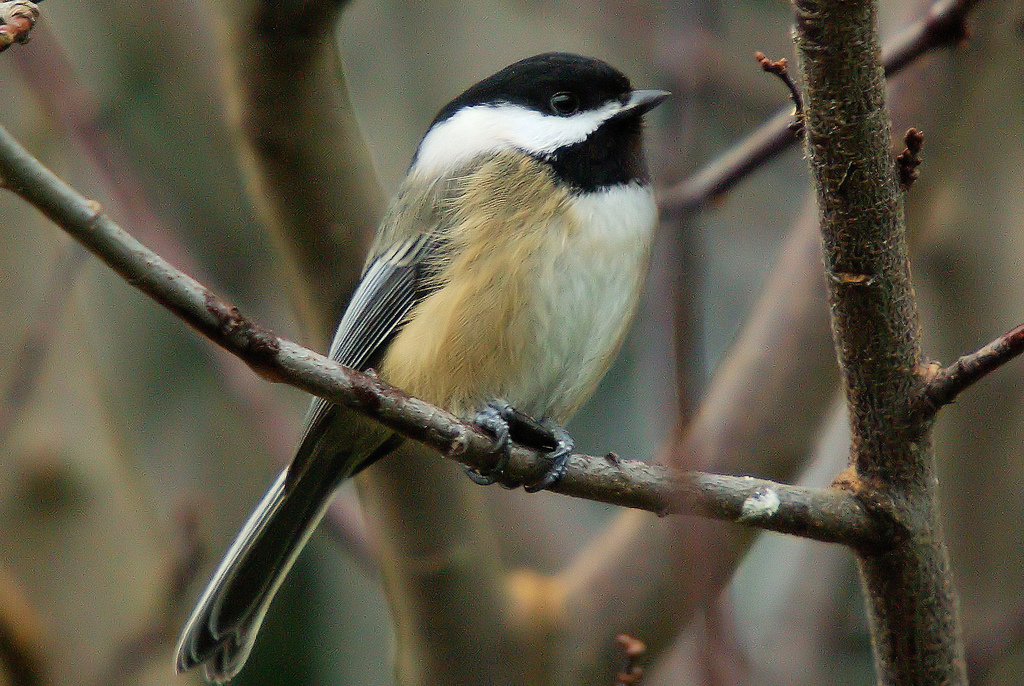
Black-capped Chickadees are one of the most beloved birds in the United States, and it’s easy to see why! These birds are often described as “cute,” as they are tiny, with an oversized head that features a black cap & bib.


 Naturally, look for Black-capped Chickadees in the United States in open deciduous forests, thickets, & cottonwood groves. They also adapt easily to the presence of people & are common to see in backyards & parks.

In fact, once you set up a new bird feeder, they will likely be the first birds to visit, as they are curious about anything new in their territory. The best foods to use include sunflower, peanuts, & suet. Their small size & athletic ability mean these birds can use just about any type of feeder!

Another great way to attract chickadees is to install appropriately sized nesting boxes around your yard. These birds are cavity nesters, which means they need an enclosed bird house to raise their young.

Here are some tips to consider before hanging up a chickadee nesting box:

- Make the diameter of the entrance hole 1-1/8 inches. This prevents larger birds, like House Sparrows, from getting inside & displacing your chickadees.
 
- Place your nest box in or at the very edge of the woods. Chickadees won’t use it if it’s in a field.

- Hang the bird house securely to a tree (don’t let it swing freely) between 5 & 15 feet high.

You can either build a nest box yourself or buy a pre-made chickadee house online.

Try identifying Black-capped Chickadees by their sounds!
 
These birds are extremely vocal, & you should have no problem hearing one. And luckily, their vocalizations are unique & relatively easy to identify. 

Listen for a song that is a simple 2 or 3 note whistle, which sounds like it’s saying “fee-bee” or “hey sweetie.”

Black-capped Chickadees also make a distinctive “chickadee-dee-dee” call. And yes, it actually sounds like they are saying their name! Interestingly, they add more “dee” notes onto the end of the call when alarmed.

 Lastly, these birds have incredible memories! They hide seeds & other foods in their territory to eat later, which are all hidden separately. Somehow, their brains can remember THOUSANDS of different hiding places!

#2. Carolina Chickadee

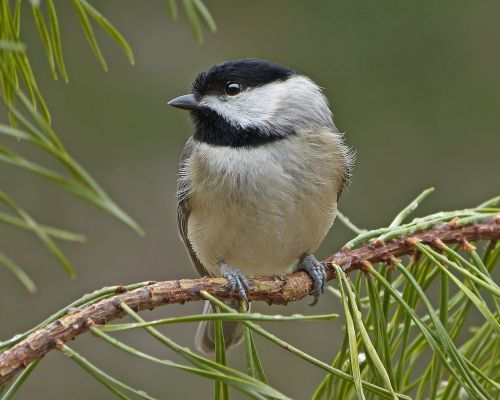
Carolina Chickadees are small birds with a distinctive black cap & bib, dull white cheeks, a gray back, & white underparts. Both males & females look the same.

Look for them in a wide variety of habitats across the southeast. You should be able to spot Carolina Chickadees in the United States in deciduous & mixed woodlands & swampy areas. They also adapt well to humans & are extremely common in parks & suburban & urban backyards!

Like most chickadees, they are intensely curious & intelligent. Try attracting them to your backyard by offering a mixture of sunflower seeds, peanuts, & suet. Because of their small size & acrobatic abilities, they can use almost every type of bird feeder.

What sounds do Carolina Chickadees make?

The most common song you will hear them making is a 4-note whistle, which sounds like “fee-bee-fee-bay.” Typically, the first & third notes are higher in pitch than the second & fourth.

They also have a call that sounds like they are saying their name “chick-a-dee-dee.” 

How can you tell Carolina & Black-capped Chickadees apart?
 
If you hadn’t noticed, these 2 birds look almost identical! Trying to tell them apart takes a lot of practice, but it can be done. Here are the best ways to identify each bird:

Location:
For the most part, these 2 birds don’t live in the same areas. Carolina Chickadees are birds of the southeast, while Black-capped Chickadees live more north. But, there is some range overlap between the 2 species, in which case you will need to rely upon another indicator.

Appearance:
At first glance, these 2 birds appear identical. But believe it or not, there are some small differences in the way they look. A Carolina Chickadee’s wings are darker & grayer. Black-capped Chickadees have white on the wing edges.

Song:
Vocalizations aren’t a ton of help where the ranges meet since each species can learn the other’s songs! The only clue you may have is that Carolina Chickadees tend to say “chick-a-dee-dee-dee” faster than Black-capped Chickadees.  With a lot of practice, you may be able to tell the difference!

#3. Mountain Chickadee

As the name suggests, if you want to find Mountain Chickadees in the United States, you will need to head to the mountains! Look for small birds with black heads & a distinctive white eyebrow, which makes them fairly easy to identify.

Like other chickadee species, these birds are agile & curious. They are most often seen flitting from tree to tree in coniferous forests, searching for insects, spiders, seeds, & nuts.

Do you have a house in the mountains?

If so, you should easily be able to attract Mountain Chickadees! Try setting up a feeding station filled with sunflower seeds, peanuts, & suet.

Listen for them singing a 3-4 note descending whistle “fee-bee-bay” or “fee-bee-fee-bee.” Some people think it sounds like they are saying “cheeseburger!”

But the most common call you will hear is “chick-a-dee-dee-dee,” which sounds very similar to a Black-capped Chickadee, even though these species tend to pay little attention to each other.

#4. Boreal Chickadee

The only chickadee in the United States with a brown cap! These birds are incredibly tough, as they live in coniferous forests in the far north all year round.

Boreal Chickadees aren’t as numerous or vocal as other chickadee species, which means it can take a bit more patience & time to locate them. But they are commonly attracted to bird feeders, which may be your best shot at seeing one since they adapt well to the presence of people!

To survive the cold & brutal northern winters, Boreal Chickadees have to hide & store A LOT of food. What’s amazing is that they can remember where they hide everything! Their main foods include insect larvae & seeds.

Boreal Chickadees are surprisingly quiet, & they don’t use songs or vocalizations to signal their breeding territory, which can make them hard to find in the forest. If you do hear one, it will be a raspy “tschick-a-dee-dee” call note, which comparatively sounds harsher than a Black-capped Chickadee.

#5. Chestnut-backed Chickadee

These chickadees are truly handsome little birds. They are easily identified by their chestnut backs & sides, which match the bark of the trees they live amongst.

Look for Chestnut-backed Chickadees in the western United States in dense coniferous forests. They can also be easily attracted to bird feeders. Just make sure your backyard has plenty of shrubs & trees they can use for cover!

During winter, it’s common to find these birds flocking together with many other species. You will frequently find them traveling with nuthatches, titmice, kinglets, & even other chickadee species.

Chestnut-backed Chickadees have a unique call when it comes to chickadees. Listen for a high, scratchy “chick-a-dee” that lasts 1 – 1.5 seconds. They also sing a series of “gargle” notes, but these noises aren’t heard often.

 Cute Critter Pics:


Weekly Chuckle: